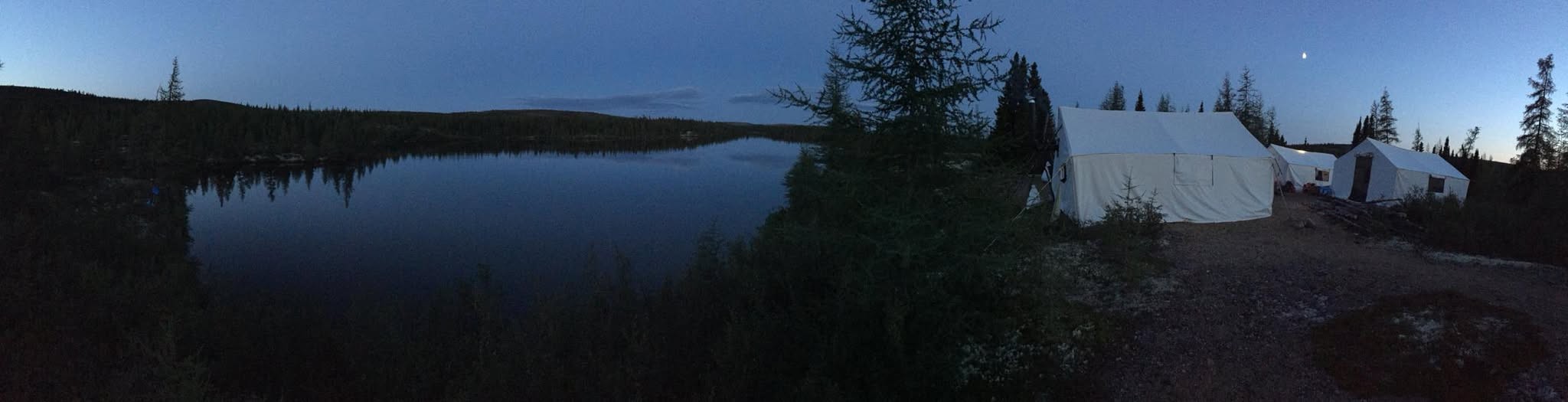
The Labrador camp at dusk: wall tents on a lake, 30 km into the interior. Two months here with a crew of five.
Three summers as an exploration field technician: helicoptered into the bush to walk soil-sample lines point by point across the tundra of Nunavut, the Labrador interior, and the Yukon goldfields. Hard manual fieldwork out of remote camps: the ground-level data collection that underpins the rest of my work.
The Labrador camp at dusk: wall tents on a lake, 30 km into the interior. Two months here with a crew of five.
Mineral exploration starts on the ground. Before anyone drills, someone has to walk the land and collect consistent soil samples that get assayed for trace metals: the geochemical anomalies that hint at gold at depth. That someone was me.
The rhythm was the same every day, in every territory. A helicopter dropped us somewhere in the wilderness with a GPS, a stack of sample bags and a line to walk. You followed the line point to point, digging and bagging a sample at each waypoint (same depth, same horizon, same care, every time) until the line was done and the helicopter came back to lift you to camp.
Consistency was the whole job. A sample taken carelessly is worse than no sample at all, because it lies in the dataset, so the discipline was to treat the thousandth point exactly as carefully as the first.
Nunavut, 2017 — Hayes Camp. My first season, at an established camp in the Committee Bay belt of the central Arctic. A large, well-run operation, so life in camp was comfortable, but the tundra sets its own terms, and a clear morning can turn to a whiteout by lunch.
Labrador, 2018 — inland from Hopedale. Two months in a remote fly-in camp about 30 km into the interior, just five of us. Buggy, soggy, and every kind of weather; and, for all that, the best of the three. Small crew, deep bush, complete self-reliance.
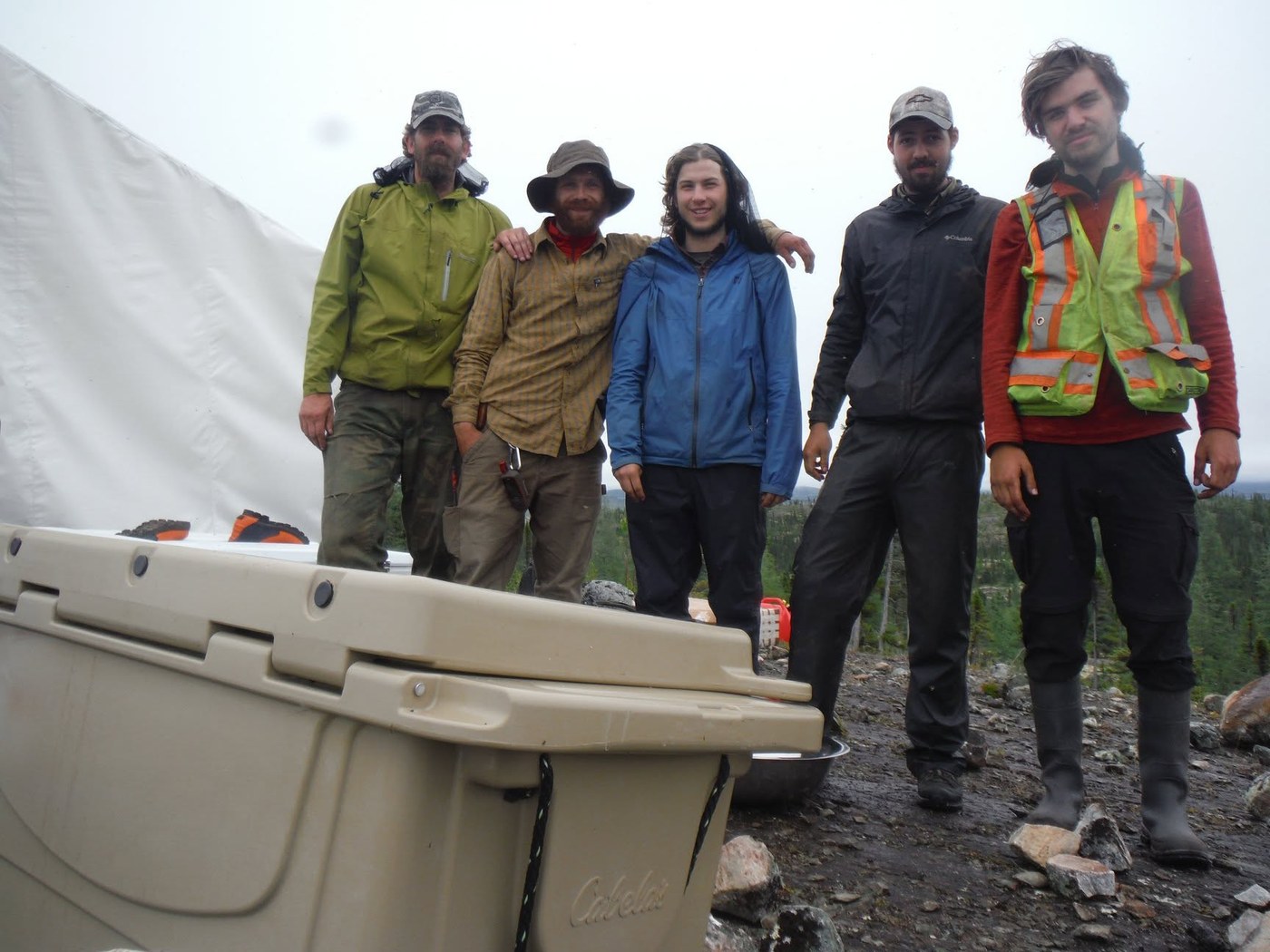
Five of us at the Labrador camp, muddy, wet, and grinning after a day on the lines. Two months, a crew of five, and every kind of weather.
Yukon, 2019 — Dawson City. The Klondike goldfields, working out of Dawson City, where GroundTruth is based. The same discipline, a different landscape.
The analysis I do now sits on top of data that somebody collected in the field, and these three summers taught me what that costs and what it's worth. Living in remote camps for months, doing hard manual work day in and day out no matter the conditions, and staying disciplined enough to collect clean, consistent samples on every last point: that is the foundation the rest of my work is built on. It is also why remote fieldwork holds no fear for me: I have done the long, wet, buggy version, and come out the far side glad I went.